
2007 Nissan Maxima Review
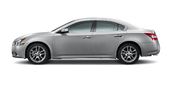 The Maxima was originally just a trim option for the Nissan Bluebird, but became its own model in 1981. The first front-wheel drive model was introduced in 1984. The car evolved over the years, but suffered a downgrade in 1998 when the independent rear suspension was removed as a cost-cutting measure. The fifth generation debuted in 2000, available in the GXE, GLE, and SE trims. In 2002, the Maxima’s engine was upgraded to 255-hp, and other features, like high-intensity discharge headlights were added. Two special editions were released in 2003: The Titanium Edition, and the Meridian Edition. The current Maxima was introduced in 2004, reintroducing the independent rear suspension and upgrading the engine to 265-hp. The Maxima SE was a mainstay on Car and Driver’s “Ten Best” list in the 1990s.
The BuyingAdvice Team Says:
The Nissan Maxima tries to match luxury with performance, and for the most part succeeds. Its a better overall value than luxury competitors, and its safety and reliability ensure confidence. While you can probably get sharper handling and more power at its price, the Maxima is the “go to” car for power, luxury, and affordability.
What’s New For 2007:
What is the Predicted Reliability:
The Maxima earned four out of five stars in J.D. Power’s initial quality survey, and an overall “Green” rating from Automotive Information Systems. The Maxima has had a number of minor reliability concerns over the years, such as noise, hard starting, and engine misfires. The Maxima was recalled twice in 2001-02 for a pin breakage that could cause odd steering and for over-traveling pedals. Expect average to above-average reliability. The standard warranty lasts for three years or 36,000 miles.
Analysis Of Safety Ratings And Features:
The Maxima earned four and a half out of five stars in frontal government crash tests, and four stars in side tests. The IIHS gave the Maxima its best “Good” rating for frontal crashes, and “Moderate” for side impacts. Rear impact data is not available for this year. The Maxima is fully loaded with safety features, including traction control, anti-lock brakes, brake assist, and full side airbags. Stability control is optional.
Pros and Cons:
Pros
+ Mighty engine
+ Roomy
+ Good assortment of safety features
Cons
– No manual transmission option
– Heavy
– Poor gas mileage
Head-To-Head Competition:
The Maxima compares well to luxury vehicles in its segment. It costs $4,000 less than the BMW 3 Series 328i, while providing more cargo capacity and 25 more hp. It costs $1,600 less than the Mercedes-Benz C-Class 230, and has a liter larger engine, more cargo room, and fifty more horses. The Subaru Legacy GT Limited, which costs the same, has standard all-wheel drive, leather seats, moonroof, and a CD changer. However, the Maxima has traction control, a liter larger engine, two more cylinders, and more cargo space.
What Others Are Saying:
“The interior benefits from an upgrade in material quality, although its design and execution actually are not up to the standards seen in the all-new Altima, the Maxima’s less expensive, smaller sibling. The 255-hp, 3.5-liter engine, one of the best V-6s in the business, carries over, and now it’s mated to a standard continuously variable transmission.” – Automobile Magazine
“The Maxima’s gas mileage is disappointingly low, and Nissan’s navigation control interface continues to try our patience. Neither the ride nor the audio system is as refined as we would expect for a car of this price.” – C|Net
“The Maxima always used to be Nissan’s sporty mid-size Sedan. Over the years, though, it has grown in size, becoming ever more luxurious and powerful but less of a driver’s car. It finished midpack in a comparison test, behind a Toyota Avalon and a Chrysler 300.” – Car and Driver
Read more about the 2007 Nissan Maxima at the Nissan manufacturer web site.


